Friday, October 28, 2016

Hacking For Good


Image result for tinfoil security


When someone thinks of hacking they usually think about getting robbed of their personal information such as credit card, social security, and any other personal information that the hacker wants. This can also happen to governments and companies who don't have sufficient security for their information databases and software. However, two MIT students developed a way to make hacking a beneficial use for many companies. Michael Borohovski and Ainsley Braun created the fast growing start-up company Tinfoil Security. Tinfoil Security uses commercialized scanning software that uses hacking to detect vulnerabilities in websites and alert developers and engineers to quickly fix the issues before the website goes active. Already, there are thousands of start-ups using the software to develop their website. Braun states that 75 percent of companies that have used the software scanned some form of vulnerability on their website. Tinfoil's website has a ticker showing how many vulnerabilities the software has detected so far and it is currently at 450,000. Braun says the company's number one goal is to secure the internet and end the threat from hackers. 

Tinfoils' software finds vulnerabilities by crawling websites, which is similar to Google. Instead of looking for texts and images, it looks for anywhere it can inject code to exploit vulnerabilities. The software doesn't have access to source code or anything else an external hacker would have, but instead goes through every possible entry point and attempt to see if their's a vulnerability. Currently, the software has techniques to detect 50 different vulnerabilities, including the Open Web Application Security Project’s top ten Web app risks. Every time a vulnerability is discovered the software can run anywhere from ten to a hundred tests. Currently, there are only five employees working at Tinfoil and they are constantly updating the software as new risks and attacks are detected. One of the most common vulnerabilities is insecure cookies. Let's say someone logs onto a website, while on a public wifi hotspot, it's possible for a hacker to steal an insecure cookie allowing them to pretend to be the user. On the user hand, the developer sees a description of the vulnerabilities, including its location and impact on the website, and step-by-step instructions on how to fix the vulnerabilities. The steps include specific programming languages that help fix the vulnerabilities. It's nice to see how individuals are using computer science to counter hackers who are using computer science for unlawful purposes. 


Example of list of vulnerabilities found on a website:

Image result for tinfoil security


Resources:
https://www.tinfoilsecurity.com/about
http://news.mit.edu/2014/tinfoil-security-catches-web-vulnerabilities-0917
https://www.cloudflare.com/apps/tinfoil-security/


Friday, October 21, 2016

LED-filled "Robot Garden" Making Coding More Appealing


Image result for LED-filled “robot garden”

The "robot garden" is dozens of changing LED lights and a hundred or more origami robots that can swim, crawl, and blossom like flowers. It was developed by a team at MIT's Computer Science and Artificial Intelligence Lab. The garden is controlled by any Bluetooth tablet-operated system that illustrates their modern research on varying algorithms through the robotic sheep, origami flowers that can blossom and change colors, and robotic ducks that can change shape when put into an oven. Researchers say the "robot garden" is a visual symbol of their latest work in computing, as well as an artistically appealing way to attract young adults to learn programming.

The system is controlled by simple "control by click" feature or "control by code" feature. "Control by click" feature allows you to control the system by clicking on individual flowers, while "control by code" feature allows you to control the garden by implementing your own commands and programs in real time. Students' ability to see their code in a physical environment causes them to understand how programming is a cool and unique ability to have. The system has sixteen tiles connected via Arduino controllers and programmed through search algorithms that test the space in different ways. One of these algorithms is 'graph-coloring' which ensures no two adjacent tiles share the same color. The garden tests different algorithms for over 100 robots, allowing a lot of experimentation on the system. For example, an MIT researcher developed a system that uses object-recognition algorithms to make robots water, harvest, and take different metrics of a vegetable garden. The "robot garden" is an example of how young students and adults need to experience the real world applications of programming in order to motivate them to understand and appreciate the unique and innovative aspects of coding,


Video Illustrating how it works:


References:
http://cacm.acm.org/news/183473-can-an-led-filled-robot-garden-make-coding-more-accessible/fulltext
http://news.mit.edu/2015/can-led-robot-garden-make-coding-more-accessible-0218
https://blog.adafruit.com/2015/02/23/can-an-led-filled-robot-garden-make-coding-more-accessible-code-robotics-womeninstem/

Friday, October 14, 2016

Solving the Issue of Drug Errors


Image result for Medeye

MIT graduate entrepreneurs Gauti Reynisson and Ívar Helgason worked for hospitals and medicare companies implementing medication safety technologies, when they realized a major health issue. 1.5 million patients in the United States experience prescription medication errors every year due to drug administration mistakes. They decided to return to MIT to find a solution to this health issue and created the MedEye. Advertised and developed by the startup Mint Solutions, MedEye has made it's way to being utilized by hospitals in the Netherlands. It has caught the attention of the medical community and the Dutch discovered ten percent of MedEye's scans caught medication errors. Mint Solutions goal is to aid nurses by selling them the MedEye in order to help them efficiently and correctly administer prescription medication. Currently, Mint Solutions is working with Dutch health care to spread the MedEye to fifteen more hospitals in countries including the UK, Belgium, and Germany.

Image result for Medeye


In order to use the MedEye, a patient must have a wristband with a barcode. The nurse scans the barcode which accesses the patients' medical record. Then the nurse puts the prescribed pills into the MedEye tray. The MedEye uses a small camera to scan the pills in order to analyze their size, shape, color, and markings. Finally, the computer science comes into play when the software distinguishes pills by grouping them in a database through the use of algorithms. What's impressive is the innovation of MedEye's software, which updates and cross-references the results in the patient's medical record. The results are illustrated by color-coded boxes, green means it was correctly prescribed and red means it was wrong or unknown. What makes the MedEye unique, Helgason says it requires no change in a hospitals' workflow or logistics, "it's more usable and accessible in health care facilities"(Stop Drug Errors). It;s great to see how computer science is becoming an important part in the innovation and growth of medicare and the administration of drugs.

References:
http://mintsolutions.eu/medeye-landing-en/#medeye-nurse-1
http://news.mit.edu/2014/startup-stops-drug-errors-0828
http://impressivemagazine.com/2013/11/02/medeye-system-reduces-medication-errors/

Friday, October 7, 2016

Detecting Emotions with Computer Science


In relationships it can sometimes be difficult to interpret what your friend or loved one is truly feeling at any time. Most of our judgements are based off of facial expressions and what they are saying. However, we all know people tend to mask their emotions because they're afraid of what others will think or do so because they want to, for example a poker face. Now with the help of computer science we can uncover the masks of society and find out what people are really feeling. MIT's Computer Science and Artificial Intelligence Laboratory researchers have worked together to create the "EQ-Radio." The EQ-Radio uses wireless signals to detect what someone is really feeling. It can detect whether somebody is happy, sad, excited, or angry by measuring any changes in breathing and heart rhythms. MIT project lead and professor Dina Katabi believes the system will be used in entertainment  and health care across the world. It could also be used to detect the consumer behavior towards a product or business.

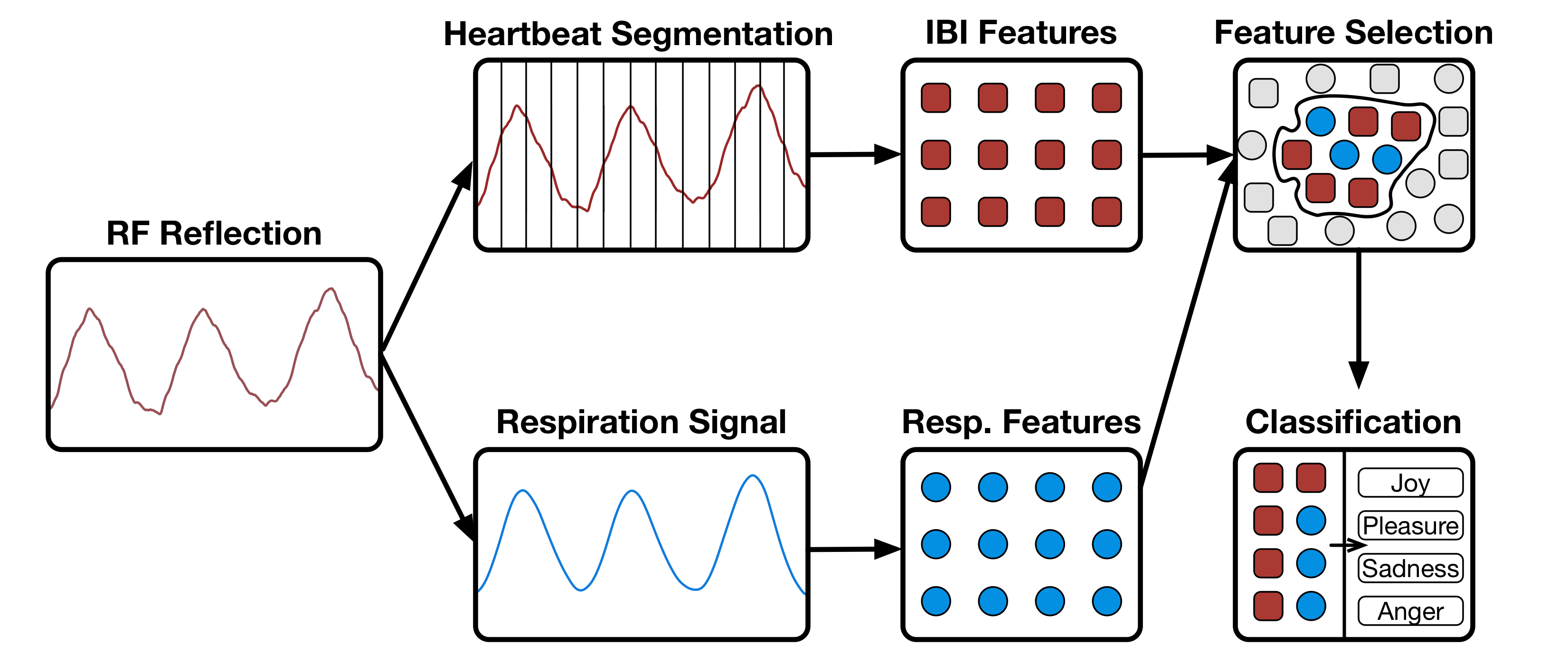
The EQ-Radio is unique compared to other technology focusing on detecting emotions. Existing emotion detecting technology systems use audiovisual cues or on-body sensors. Both systems are unreliable because facial expressions can be masked and on-body sensors can be very uncomfortable and innacurate if its constantly moving around. The EQ-Radio uses wireless signals that are sent to someone and then reflected off their body going back to the device. Then the system has programmed algorithms that convert the reflections down into individual heartbeats. The device analyzes these heartbeats to measure levels of arousal and positive effect. These measurements are what give the EQ-Radio the power to detect different emotions. So if someone has low levels of arousal and negative effect then they're sad and if the levels of arousal are high and theres positive effect then they're excited. On the other hand, the EQ-Radio has been tested to only be accurate 87 percent of the  time, so if you have a really good poker face you still might be able to deceive the device.


References:
http://news.mit.edu/2016/detecting-emotions-with-wireless-signals-0920
http://eqradio.csail.mit.edu/
https://www.engadget.com/2016/09/20/eq-radio-wireless-signals-emotion-detector/