
In relationships it can sometimes be difficult to interpret what your friend or loved one is truly feeling at any time. Most of our judgements are based off of facial expressions and what they are saying. However, we all know people tend to mask their emotions because they're afraid of what others will think or do so because they want to, for example a poker face. Now with the help of computer science we can uncover the masks of society and find out what people are really feeling. MIT's Computer Science and Artificial Intelligence Laboratory researchers have worked together to create the "EQ-Radio." The EQ-Radio uses wireless signals to detect what someone is really feeling. It can detect whether somebody is happy, sad, excited, or angry by measuring any changes in breathing and heart rhythms. MIT project lead and professor Dina Katabi believes the system will be used in entertainment and health care across the world. It could also be used to detect the consumer behavior towards a product or business.
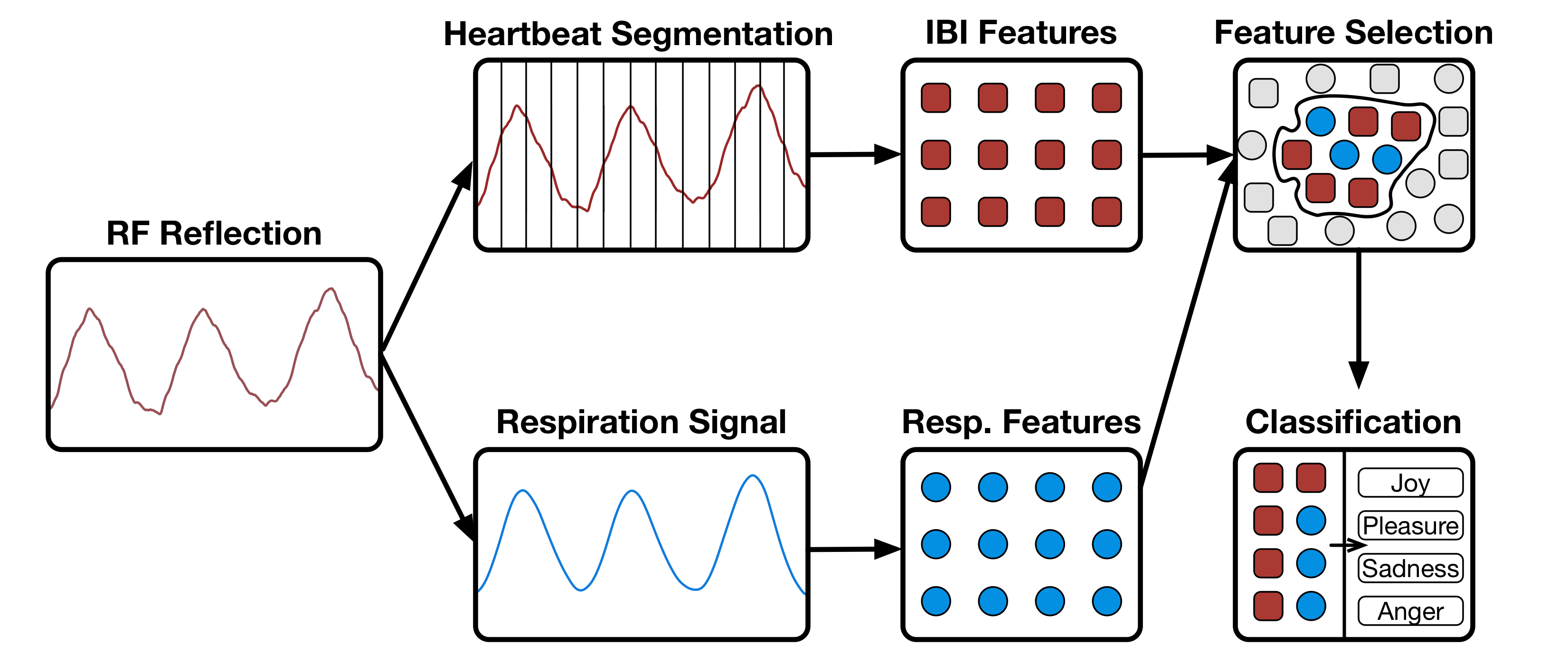
The EQ-Radio is unique compared to other technology focusing on detecting emotions. Existing emotion detecting technology systems use audiovisual cues or on-body sensors. Both systems are unreliable because facial expressions can be masked and on-body sensors can be very uncomfortable and innacurate if its constantly moving around. The EQ-Radio uses wireless signals that are sent to someone and then reflected off their body going back to the device. Then the system has programmed algorithms that convert the reflections down into individual heartbeats. The device analyzes these heartbeats to measure levels of arousal and positive effect. These measurements are what give the EQ-Radio the power to detect different emotions. So if someone has low levels of arousal and negative effect then they're sad and if the levels of arousal are high and theres positive effect then they're excited. On the other hand, the EQ-Radio has been tested to only be accurate 87 percent of the time, so if you have a really good poker face you still might be able to deceive the device.
References:
http://news.mit.edu/2016/detecting-emotions-with-wireless-signals-0920
http://eqradio.csail.mit.edu/
https://www.engadget.com/2016/09/20/eq-radio-wireless-signals-emotion-detector/

This is so cool!! Especially this is wireless. I remembered reading about Microsoft’s vision-based “Emotion API”, which recognizes the facial expressions on images. To read more about Emotions API, read from this link:https://www.microsoft.com/cognitive-services/en-us/emotion-api
ReplyDeleteBut EQ Radio seems to be more accurate in detecting emotions. This would be extremely helpful in applications, especially for the police. This tool looks really new. I was wondering how does this tool tune out irrelevant data like breathing? What is the projected percent of accuracy? I know MIT currently has it, when would it be manufactured in mass?